


Peppol Certification in Oman: The Fastest Route to E-Invoicing Compliance Under Fawtara
For fifteen years we have watched compliance deadlines arrive the same way: slowly, then all at once. Oman’s invoicing transformation is following that script exactly. The Oman Tax Authority became a Peppol Authority on 7 January 2026, the Fawtara pilot went live in August 2026 with the country’s largest taxpayers, and suddenly every finance director in Muscat is asking the same question about e-invoicing in Oman — how do we actually get Peppol certification in Oman before our invoices stop clearing?
This guide answers that. Not with vendor marketing, but with the sequence that works: understand the mandate, understand the network, then build the evidence that certification bodies and the OTA will actually accept. If you are responsible for e-invoicing in Oman, this is the roadmap.
Oman’s E-Invoicing Mandate Is No Longer a Future Problem
The rollout of e-invoicing in Oman is phased, and the phases are tighter than most boards realise.
- August 2026 (Phase 1): Pilot with roughly 100–144 of the largest VAT-registered taxpayers.
- February 2027 (Phase 2): All large VAT-registered businesses.
- August 2027 (Phase 3): SMEs and remaining VAT-registered entities.
- 2028 (Phase 4): Business-to-Government transactions.
Read that again. If you are a large taxpayer, mandatory e-invoicing in Oman is roughly six months away. If you are an SME, you have a year — which sounds generous until you learn that the security certification underpinning the whole model takes six to twelve months to earn. That gap is where most compliance projects die, and it is precisely why Peppol certification in Oman has become the boardroom conversation it is today.
The scope is broad. There are no permanent exemptions by company size. Zero-rated supplies stay in scope. Invoices must be retained for ten years — five in-system and five in electronic archive — and fifteen years for real estate. Adoption of e-invoicing in Oman is not a finance-department IT upgrade; it is a records, security and governance obligation.
Why Peppol Certification in Oman Sits at the Heart of Fawtara
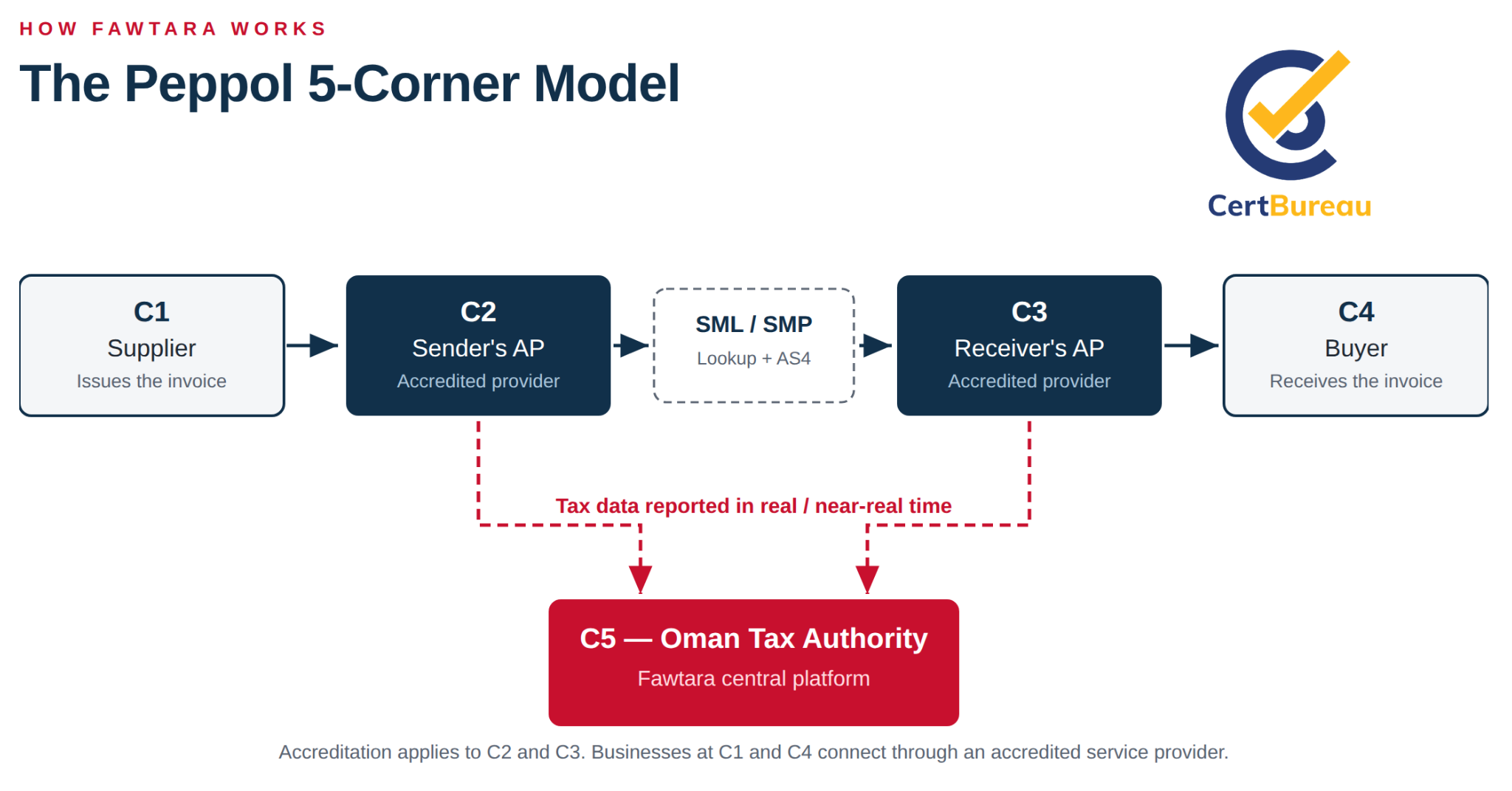
Oman did not build a proprietary clearance platform. It adopted the Peppol five-corner model, and that single design decision explains why Peppol certification in Oman matters more than any software licence you will buy.
In the five-corner model, the supplier issues an invoice, sends it to their accredited service provider, that provider transmits it across the Peppol network to the buyer’s provider, the buyer receives it — and, simultaneously, tax data is reported to the OTA’s Fawtara platform. Five corners, one flow — that is e-invoicing in Oman.
Technically, that means UBL 2.1 XML built to the PINT-OM specification, roughly 53 mandatory data fields, Arabic and English support, QR codes on B2C invoices, and near-real-time transmission (B2C gets a 24-hour window). Every invoice must pass through an OTA-accredited service provider for validation before it reaches the buyer. There is no side door. Compliant e-invoicing in Oman means being on the network, correctly, with a certified partner.
What “Peppol Certification in Oman” Actually Means
Here is where I see the most expensive confusion, so let me separate two things clearly.
If you are a service provider — an Access Point (AP), a Service Metadata Publisher (SMP), an ERP vendor or an ISV routing Omani invoices — Peppol certification in Oman means being accredited by the OTA to operate on the Peppol network, and meeting OpenPeppol’s own service provider obligations. That is your licence to operate e-invoicing in Oman.
If you are a taxpayer — a manufacturer, contractor, retailer, logistics firm — you do not personally become an Access Point. But your readiness for e-invoicing in Oman depends entirely on the assurance posture of the provider you choose and the controls you can evidence in your own environment. Buyers, auditors and tenders increasingly ask for both.
Either way, the requirement now converges on one internationally recognised standard. And that is the part of Peppol certification in Oman almost nobody had priced in twelve months ago.
The ISO 27001 Deadline That Changed E-Invoicing in Oman
In 2026 the OpenPeppol Managing Committee confirmed that ISO/IEC 27001 certification is mandatory for all Peppol Service Providers from 1 July 2027 — Access Points and SMPs alike, including ISVs whose products route documents through third-party APs. It supersedes the patchwork of national security requirements with a single global bar.
The submission calendar is already running: equivalence requests were due 30 June 2026, existing certificates by 1 September 2026, evidence of in-progress projects by 1 October 2026, with progress reports due 1 February and 1 May 2027. There is no self-declaration escape hatch. Lose the certification, lose the accreditation — and every client’s invoice flow stops with it.
Critically, a generic certificate will not pass. Your Statement of Applicability must explicitly cover Peppol operations: Access Point and SMP functions, end-user identification, document management, integrity controls, logging and audit trails, backup and business continuity. This is the technical heart of Peppol certification in Oman, and it is where unprepared applicants fail.
Do the arithmetic. An ISMS takes four to six weeks to implement, run, internally audit and certify. It is August 2026. Anyone starting Peppol certification in Oman in 2027 is already late.
Your Practical Checklist for Peppol Certification in Oman
Before you commit budget to e-invoicing in Oman, work through this:
- Confirm your phase date and VAT registration status against the OTA schedule.
- Choose an OTA-accredited provider — and ask for their ISO 27001 certificate and SoA, not a promise.
- Map your invoice data to PINT-OM’s mandatory fields; most ERP gaps surface here.
- Define your ISMS scope to include Peppol operations explicitly.
- Fix your archiving for the ten-year (and fifteen-year) retention rules.
- Run a gap assessment against ISO 27001 Annex A, then remediate before the audit — not during it.
- Test in the sandbox well before your live e-invoicing in Oman go-live date.
Complete those seven and Peppol certification in Oman becomes an administrative exercise rather than a crisis. Skip step four or six, and it becomes both expensive and slow.
How CertBureau Helps You Achieve Peppol Certification in Oman
CertBureau has spent years doing exactly one thing well in the Sultanate: turning standards into certificates that hold up under audit. With ISO 27001 now the gatekeeper for the Peppol network, that expertise sits directly on the critical path to Peppol certification in Oman.
Peppol-scoped ISO 27001 implementation. We build the ISMS around your actual Access Point, SMP and document-exchange operations, drafting a Statement of Applicability that satisfies OpenPeppol’s explicit coverage requirements rather than a template that fails first review.
Gap assessment and remediation. A structured review of your current controls against Annex A and the Peppol obligations, with a prioritised, dated remediation plan mapped to your phase deadline for e-invoicing in Oman.
Supporting standards under one roof. ISO 9001 for process discipline, ISO 20000-1 for IT service management, ISO 22301 for the business continuity controls Peppol expects, and VAPT to harden the interfaces that carry live invoice traffic.
Documentation, training and audit support. Policies, procedures, internal audits, staff awareness and management review — then hands-on support through Stage 1 and Stage 2. Our onsite and online delivery model across Oman means the timeline for Peppol certification in Oman fits your operational reality, not ours.
The outcome we aim for is simple: certification that regulators, buyers and OpenPeppol accept the first time.
Don’t Let the Deadline Choose For You
Non-compliant invoices are not merely late — under a five-corner model they are unclearable. That means blocked receivables, failed tenders and VAT exposure. Every month you delay Peppol certification in Oman compresses an ISMS programme that genuinely cannot be compressed much further.
Phase 1 of e-invoicing in Oman is live. Phase 2 lands February 2027. The ISO 27001 gate closes 1 July 2027. If your organisation intends to keep invoicing, start now — Peppol certification in Oman begins with the standard everything else depends on.
Talk to CertBureau in Muscat. Our Al Khuwair team offers a no-obligation readiness assessment for Peppol certification in Oman, so you know exactly where you stand and what it takes to be compliant with e-invoicing in Oman before your phase date arrives.