


E-Invoicing in Oman: ISO 27001 ISMS Ultimate Guide
Introduction: The Invoice Just Became a Regulated Data Asset
For most of the last two decades, an invoice was a document. You printed it, signed it, filed it, and if the tax auditor asked, you dug it out of a cabinet. That era is closing. With the Oman Tax Authority’s phased rollout now underway, e-invoicing in Oman turns every commercial transaction into a structured, machine-readable data packet that travels across a national network in near real time.
That single shift changes the risk conversation completely. Under e-invoicing in Oman, an invoice is no longer just an accounting artefact — it is a live data flow carrying your customer identities, VAT numbers, pricing, margins, bank details and supply chain relationships. It moves through APIs, service providers and cloud platforms. It must remain tamper-evident for a decade. And it is now visible to a regulator.
In fifteen years of writing about management systems, I have rarely seen a compliance programme that so cleanly exposes the gap between “we have an IT team” and “we have an information security management system.” Organisations that already run a certified ISMS are treating the transition as a project. Organisations that do not are discovering, uncomfortably late, that e-invoicing readiness is 30% tax configuration and 70% information security governance.
This article walks through what is coming, what regulators and trading partners will expect, how ISO/IEC 27001 gives you a ready-made control framework for it, and how CertBureau helps Omani organisations build an ISMS that is genuinely invoice-ready.
Where Oman Stands Right Now
The national platform is called Fawtara, developed by the Oman Tax Authority in partnership with Omantel. Understanding the Fawtara e-invoicing model matters, because its architecture — not your accounting habits — dictates your security obligations. Anyone planning for e-invoicing in Oman should start with the mechanics of how the Fawtara e-invoicing network actually moves a document.
The revised timeline
On 9 August 2026, the Oman Tax Authority issued Decision No. 189/2026, adjusting the implementation schedule. The current phasing is:
| Phase | Who is in scope | Go-live |
| Pilot | ~100 selected large taxpayers | August 2026 |
| Phase 1 | Taxpayers exceeding OMR 5 million in annual supplies | 1 April 2027 |
| Phase 2 | All remaining VAT-registered businesses, including SMEs | 1 October 2027 |
| B2G | Government entities | February 2028 |
The dates moved outward by roughly two months for Phases 1 and 2. Treat that as breathing room, not a reprieve. Every organisation I have spoken to that used a delay to pause preparation ended up paying more later — in rushed integration work, emergency consultancy and avoidable audit findings.
The technical model
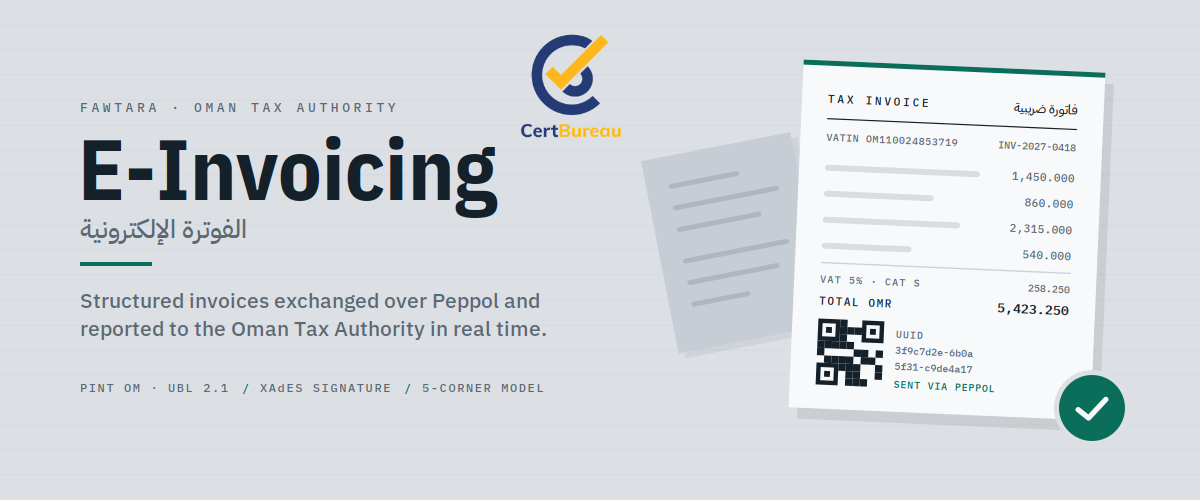
Oman has adopted the Peppol five-corner model using the PINT-OM specification (Peppol International Invoice — Oman), which layers Omani tax requirements onto the global Peppol framework and the EN 16931 semantic standard. In practice this means:
- Invoices are exchanged as XML UBL 2.1 documents, not PDFs.
- You do not connect directly to the Tax Authority. You connect through an Accredited Service Provider (ASP) registered on the Fawtara portal, which handles Peppol Access Point connectivity and your registration in the Service Metadata Publisher.
- Three document processes are defined: PINT OM Billing (invoices and credit notes), PINT OM Self-Billing (buyer-issued invoices), and the Tax Data Document (TDD) reported to the Oman Tax Authority.
- B2C transactions follow a reporting model: the consumer receives a human-readable invoice (PDF/A-3 or printed) with a mandatory QR code containing seller name, VAT number, timestamp, invoice total, VAT amount and seller UUID, while the TDD is submitted to the authority — generally within 24 hours of issuance.
- Archiving is your problem. Records, including electronic invoices, must be retained for 10 years, and the Tax Authority platform is not expected to provide an archiving service.
- Penalties under Article 202 of the VAT Executive Regulations run from OMR 500 to OMR 5,000 per violation.
Why This Is an Information Security Problem, Not Just a Tax Project
Here is the honest framing that finance directors preparing for e-invoicing in Oman need to hear.
- You are widening your attack surface on purpose. Joining the Fawtara e-invoicing network is, technically, an integration project. Connecting your ERP to an external network via API creates a new, permanently open, business-critical channel. Credential theft against that channel is not theoretical — invoice fraud and business email compromise already cost GCC organisations heavily, and a compromised e-invoicing pipeline is a far more efficient attack path than a spoofed email.
- You are handing sensitive data to a third party. Your ASP becomes custodian of your entire transactional record. Their control environment is now part of your risk posture. Alignment with recognised information security principles — controls consistent with ISO/IEC 27001 — has become a material due-diligence criterion when selecting a provider.
- Integrity now has legal weight. For ten years, you must be able to demonstrate that an archived invoice is authentic and unaltered. Backups are not the same thing as integrity assurance. Without hashing, access control, immutability and logging, you cannot prove much of anything to an auditor.
- Availability becomes a compliance issue. E-invoicing in Oman runs to submission windows. If your integration is down and you cannot transmit within the required window, you are not merely inconvenienced — you are potentially non-compliant, per violation.
- Personal data rules apply in parallel. Oman’s Personal Data Protection Law (Royal Decree 6/2022) entered its enforcement phase on 5 February 2026. Invoices routinely contain personal data. That brings consent and notice obligations, a 72-hour breach notification duty, a requirement to appoint a Data Protection Officer, controls on cross-border transfers, and a 45-day window to respond to data subject requests. Any organisation planning for the Fawtara e-invoicing transition without mapping it against PDPL is building half a compliance programme.
How ISO/IEC 27001 Solves the Problem You Are About to Have
ISO/IEC 27001:2022 is the international standard for an Information Security Management System. It is not a technology product and not a checklist — it is a governance framework that requires you to identify information risks, treat them with justified controls, and prove the whole thing keeps working. Its Annex A contains 93 controls across four themes: organisational, people, physical and technological.
The reason it fits e-invoicing in Oman so well is that the standard was designed around exactly these questions: who owns this data, who can touch it, how do we know it has not changed, and how do we prove it.
Mapping ISO 27001 controls to Fawtara obligations
| E-invoicing risk | What ISO/IEC 27001:2022 gives you |
| ERP-to-ASP integration exposed | A.8.20–A.8.23 network security, segregation and filtering; A.8.26 application security requirements |
| API credentials and certificates leaking | A.5.16–A.5.18 identity and access rights; A.8.5 secure authentication; A.8.24 use of cryptography |
| Third-party (ASP) failure or breach | A.5.19–A.5.22 supplier relationships and ICT supply chain security, with contractual security clauses and ongoing monitoring |
| Invoice tampering across a 10-year retention period | A.8.24 cryptography; A.5.33 protection of records; A.8.10 information deletion; A.8.12 data leakage prevention |
| No forensic trail during a tax audit | A.8.15 logging; A.8.16 monitoring activities; A.8.17 clock synchronisation — critical when invoice timestamps carry legal weight |
| Downtime blocking submission deadlines | A.5.29–A.5.30 continuity and ICT readiness for business continuity; A.8.14 redundancy |
| Staff mishandling invoice data | A.6.3 awareness and training; A.5.10 acceptable use; A.6.6 confidentiality agreements |
| Personal data inside invoices (PDPL overlap) | A.5.34 privacy and protection of PII; A.5.31 legal and contractual requirements |
| Uncontrolled change to invoice logic | A.8.32 change management; A.8.31 separation of development, test and production |
Beyond Annex A, the management-system clauses do the heavy lifting: Clause 6.1 forces a documented risk assessment of your invoicing data flows, Clause 8 keeps operational controls running, Clause 9 requires internal audit and management review, and Clause 10 drives corrective action. That cycle is what turns a one-off go-live into sustained compliance — and it is the difference between passing your first Fawtara e-invoicing audit and passing every one after it.
The commercial argument
There is also a straightforwardly commercial case. As e-invoicing in Oman expands into Phase 2 and B2G in 2028, large buyers and government entities will increasingly ask suppliers to evidence their security posture. An ISO 27001 certificate answers that question in one page, instead of forty rounds of vendor questionnaires. For service providers, systems integrators and accounting firms in the Fawtara e-invoicing ecosystem, certification is fast becoming table stakes rather than a differentiator.
A Practical Readiness Checklist
Whether your go-live is April 2027 or October 2027, the preparation sequence for e-invoicing in Oman is the same:
- Confirm your phase and threshold. Calculate annual supplies against the OMR 5 million line and identify which entities in your group are in scope.
- Map the data flow end to end. From ERP or POS, through middleware, to the ASP, to Peppol, to the Oman Tax Authority, and into archive. Every hop is a control point.
- Clean your master data. VAT numbers, legal names in Arabic and English, item codes, unit measures, tax categories. UBL validation is unforgiving; most pilot failures are data quality failures.
- Select your ASP on security, not only price. Ask for their certification scope, statement of applicability, data residency position, sub-processor list, incident response SLA and breach notification commitment.
- Run a formal information security risk assessment of the invoicing process, with named owners and treatment decisions.
- Design the 10-year archive. Immutability, integrity verification, retrieval testing, access logging, and a documented retention and deletion policy.
- Rehearse failure. What happens if the ASP is down for six hours? Who is authorised to reissue? Where is that documented?
- Align with PDPL. Privacy notice, DPO appointment, cross-border transfer basis, and a 72-hour breach playbook that your finance team actually knows about.
- Train the people who touch invoices — AR, AP, IT and customer service — not just the project team.
- Test, then internally audit, then go live. In that order.
Mistakes I keep seeing
- Treating it as an IT ticket rather than a cross-functional programme with executive sponsorship.
- Assuming the ASP’s certification covers your obligations. It does not — your controls remain yours.
- Confusing backup with archiving and archiving with integrity.
- Building for the pilot invoice types only, then discovering credit notes, self-billing and imports behave differently.
- Waiting for the deadline. Certification bodies and consultants in Oman will be capacity-constrained through 2027 as the whole market prepares for e-invoicing in Oman at once; the queue is real.
How CertBureau Gets Your ISMS Ready for E-Invoicing
Reading the requirements is one thing; building the management system behind them is another. This is the work CertBureau does with organisations preparing for e-invoicing in Oman.
CertBureau is an ISO consulting and certification partner with an office in Al Khuwair, Muscat, and staff who work inside Omani business culture rather than at a distance from it. Alongside ISO 27001, the firm supports ISO 9001, ISO 14001, ISO 45001, ISO 22000, CE marking, RoHS and VAPT — which matters when your invoicing programme touches quality, continuity and technical testing at the same time.
Here is how a typical engagement runs when the driver is Fawtara e-invoicing readiness.
- Scoping and gap analysis. Consultants map your invoicing data flows against ISO/IEC 27001:2022 and produce a prioritised gap report — what is missing, what is weak, and what is already fine. You get a realistic timeline instead of a generic one.
- Risk assessment and Statement of Applicability. A documented risk assessment covering ERP integration, ASP dependency, cryptographic key handling, archive integrity and PDPL exposure, with control selection justified in a defensible SoA.
- Documentation and control implementation. Written for the Fawtara e-invoicing process specifically: policies, procedures, access control matrices, supplier security clauses for your ASP contract, logging and monitoring standards, retention schedules, and incident response runbooks — customised to your operation, not copied from a template pack.
- Awareness and role-based training. Delivered onsite or online, in the language your teams work in, with content targeted at the finance and AR staff who will actually handle the new process.
- Internal audit and management review. A dry run against the same criteria the certification body will use, so that findings surface while they are still cheap to fix.
- Certification support and post-certification continuity. Support through Stage 1 and Stage 2 audits, and up to three years of ongoing engagement with periodic visits — which aligns neatly with the surveillance-audit cycle and with the staged nature of e-invoicing in Oman, where your scope will keep expanding as later phases land.
CertBureau’s certificates are accepted by Omani government agencies and recognised internationally, and clients get access to CertBureau Connect and ISO tender documentation packages — useful when you are bidding for work where certification is a qualification criterion.
Frequently Asked Questions
Is e-invoicing mandatory for every business in Oman?
E-invoicing in Oman becomes mandatory in phases. Large taxpayers above OMR 5 million in annual supplies are in scope from 1 April 2027, and all remaining VAT-registered businesses from 1 October 2027, with government entities onboarding from February 2028. Organisations outside their phase may join voluntarily.
Does ISO 27001 certification make me compliant with the tax rules?
No, and be wary of anyone who says otherwise. ISO 27001 does not replace tax compliance. It gives you the governance, controls and evidence to protect the invoicing process, satisfy trading-partner due diligence, and meet the security expectations that surround the Fawtara e-invoicing framework.
Can we keep issuing PDF invoices?
Not as the legal invoice. Structured XML UBL 2.1 becomes the compliant document; the human-readable PDF with a QR code serves the customer, particularly in B2C. This is one of the biggest practical adjustments for organisations moving to e-invoicing in Oman.
How long does ISO 27001 certification take?
For a mid-sized organisation, typically three to six months from gap analysis to Stage 2 audit, depending on scope, existing maturity and how quickly evidence accumulates. Starting now means you are certified well before your Fawtara e-invoicing phase goes live.
What should we ask a service provider before signing?
Certification scope, statement of applicability, where invoice data is stored, sub-processor list, breach notification timelines and uptime commitments. In the Fawtara e-invoicing model your provider sits inside your compliance perimeter, so their controls are effectively your controls.
Who is responsible if our service provider suffers a breach?
Contractually it depends on your agreement; reputationally and under PDPL, the accountability largely stays with you as data controller. That is exactly why supplier security controls sit at the centre of an ISMS built for Fawtara e-invoicing.
Closing Thought
The organisations that will handle the Fawtara e-invoicing transition well are not necessarily the ones with the biggest IT budgets. They are the ones that recognised early that a national invoicing network is, at heart, a shared information system — and that participating in it safely requires a management system, not a plug-in.
ISO/IEC 27001 already contains the answers to the questions e-invoicing in Oman is about to ask you: who owns this data, who can access it, how do we know it has not been altered, how do we recover when something breaks, and how do we prove all of it. Building that capability takes months. The deadlines are measured in months.
If you would like a gap analysis against your current invoicing data flows, CertBureau’s team in Muscat can start that conversation this week.